
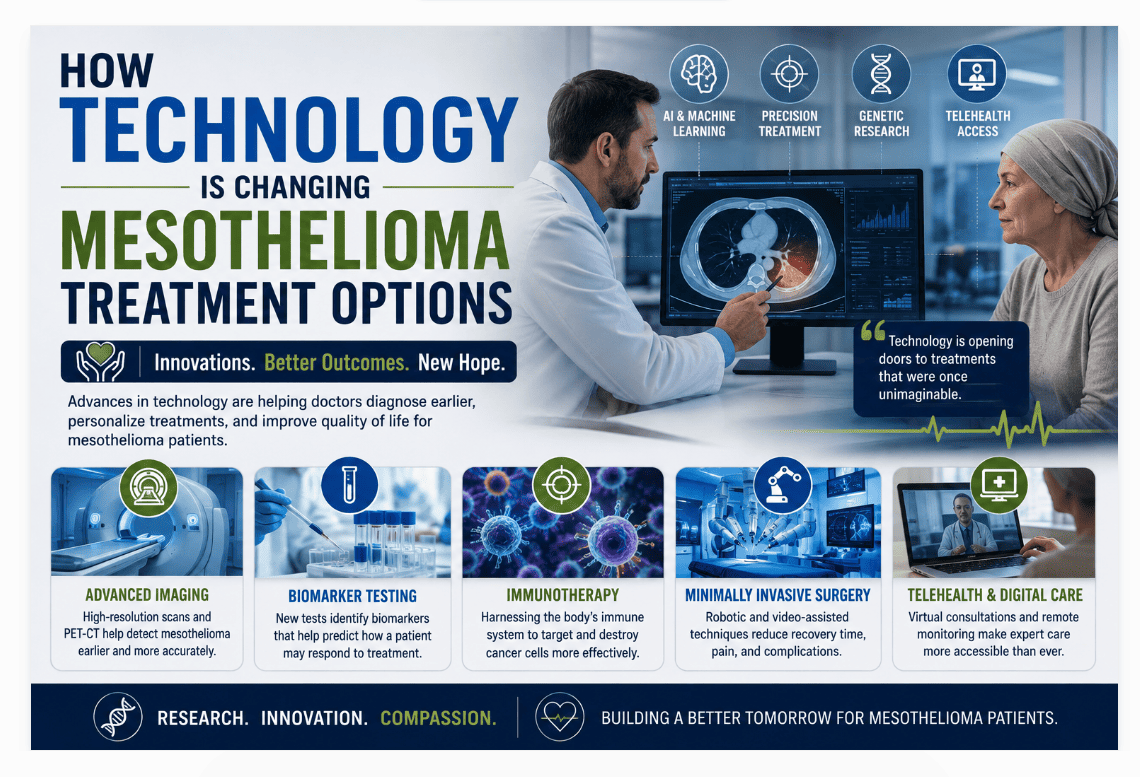
Mesothelioma has always been difficult to treat. The cancer is rare, often diagnosed late, and tends to resist standard approaches. For decades, patients and doctors relied mainly on surgery, chemotherapy, and radiation, with limited success in many cases. Today, technology is steadily changing that picture. Artificial intelligence, robotic systems, remote monitoring tools, and more precise forms of treatment are giving doctors better ways to detect the disease earlier, target it more accurately, and support patients throughout care.
These advances do not yet offer a universal cure. They do, however, expand options, reduce some side effects, and improve the experience of treatment for many people. Understanding what is available helps patients and families ask informed questions and work more effectively with their medical teams.
Why Technology Matters in Mesothelioma Care
Mesothelioma develops in the thin lining that covers the lungs, abdomen, or other organs. Because symptoms such as shortness of breath, chest pain, or fatigue can mimic more common conditions, diagnosis frequently occurs after the cancer has already advanced. Traditional treatments then face a harder task.
Technology addresses several longstanding problems at once. Imaging analysis tools can spot subtle changes that human readers sometimes miss. Minimally invasive surgical systems reduce the physical toll of operations. Remote monitoring allows closer oversight without constant hospital visits. Genetic information guides drug selection so that therapies match the biology of an individual tumor more closely.
The result is a gradual shift toward care that is more precise, less disruptive, and better adapted to each patient’s situation.
Artificial Intelligence in Diagnosis and Planning
Artificial intelligence is already improving how doctors interpret scans. Algorithms trained on large collections of CT, PET, and MRI images can highlight areas that may represent early tumor growth or subtle progression. These systems do not replace radiologists. They act as a second set of eyes that flags findings for closer review.
Machine learning models also help estimate how a particular tumor might respond to different treatments. By analyzing patterns from previous cases, the software can support more individualized planning. Liquid biopsies—blood tests that look for fragments of tumor DNA—are another area where AI assists. These tests offer a less invasive way to monitor for recurrence or treatment response over time.
For people with known asbestos exposure, improved screening tools may eventually allow detection at earlier stages, when more treatment options remain open. The technology is still evolving, yet the direction is clear: faster, more consistent analysis of complex medical data.
Robotic-Assisted Surgery
Robotic systems give surgeons greater precision and control during operations. In pleural mesothelioma, robotic-assisted approaches allow removal of diseased tissue through smaller incisions. Patients often experience less blood loss, lower infection risk, and shorter hospital stays compared with traditional open surgery.
For peritoneal mesothelioma, robotic platforms can assist with cytoreductive surgery and the delivery of heated chemotherapy (HIPEC). The enhanced visualization and dexterity help surgeons work more thoroughly while protecting nearby organs.
Not every patient is a candidate for robotic procedures. Tumor location, overall health, and the surgeon’s experience all influence the decision. When appropriate, however, the technology reduces the physical impact of major surgery and supports faster recovery.
Telemedicine and Continuous Monitoring
Travel to specialized centers can be exhausting and expensive. Telemedicine reduces some of that burden. Patients can meet with oncologists, discuss test results, and adjust treatment plans through secure video visits. This option is especially useful for follow-up care and for people who live far from major cancer centers.
Wearable devices and remote monitoring systems add another layer of support. Sensors that track heart rate, oxygen levels, activity, and sleep patterns send information to the care team. When readings fall outside expected ranges, clinicians can intervene earlier. Patients undergoing immunotherapy or other regimens that require close observation benefit from this ongoing connection without needing frequent clinic trips.
These tools work best when paired with clear communication protocols so that patients know when to report new symptoms and when the system will alert their doctors automatically.
Precision Medicine and Genomic Insights
Every mesothelioma tumor has its own genetic profile. Precision medicine uses that information to guide treatment choices. Sequencing technology identifies mutations or molecular features that may respond to specific targeted drugs or immunotherapies.
This approach moves away from treating all patients with the same combination of chemotherapy. Instead, doctors can select agents more likely to work against the particular biology of the cancer. Pharmacogenomic testing further helps by showing how an individual patient is likely to process certain medications, which can reduce toxicity.
Research continues into gene-editing techniques and other advanced methods. While many of these remain investigational, the underlying principle—matching treatment to the tumor’s characteristics—is already influencing clinical practice at major centers.
Tumor Treating Fields and Refined Radiation
Tumor Treating Fields (TTFields) use low-intensity electric fields to interfere with cancer cell division. Portable devices deliver the therapy while patients go about daily activities. When combined with chemotherapy, the approach has shown benefit in selected patients with pleural mesothelioma.
Radiation technology has also advanced. Techniques such as proton therapy and intensity-modulated radiation deliver higher doses to the tumor while limiting exposure to surrounding healthy tissue. This precision matters especially in the chest, where the lungs, heart, and esophagus sit close to the treatment area. Reduced damage to normal structures translates into fewer long-term side effects for many patients.
Emerging Tools and Supportive Technologies
Three-dimensional printing is finding limited but useful roles. Custom implants or surgical guides can help reconstruct tissue after extensive resection. In research settings, printed models of a patient’s anatomy allow surgical teams to rehearse complex procedures in advance.
Drug-delivery systems that use nanoparticles or other carriers are under investigation. The goal is to concentrate medication at the tumor site while sparing the rest of the body. These approaches remain largely experimental but illustrate the broader trend toward greater precision.
Realistic Benefits and Current Limitations
Technology has improved several aspects of care:
- Earlier or more accurate detection in some cases
- Less invasive surgical options for eligible patients
- Better matching of drugs to tumor biology
- Reduced travel burden through telemedicine
- Closer monitoring of side effects between visits
At the same time, important limitations remain. Advanced tools are not equally available everywhere. Cost can create barriers, although insurance coverage and, in some cases, compensation from asbestos-related claims help offset expenses. Data privacy and the need for reliable internet access affect telemedicine and remote monitoring. Most importantly, technology works best when guided by experienced clinicians who understand both the tools and the individual patient.
Practical Considerations for Patients and Families
Ask the oncology team which technologies are relevant to the specific diagnosis and stage of disease. Not every advance applies to every person. Inquire about clinical trials that incorporate new approaches; these studies often provide access to promising methods under careful supervision.
Discuss logistical issues early. If travel is difficult, explore telemedicine options or satellite clinics affiliated with major centers. If financial concerns arise around specialized equipment or procedures, social workers and patient navigators can help identify resources, including possible compensation pathways related to asbestos exposure.
Keep records of all imaging, pathology, and genomic reports. These documents become valuable when seeking second opinions or enrolling in research studies that rely on detailed molecular information.
Frequently Asked Questions
Can artificial intelligence diagnose mesothelioma on its own?
No. AI tools assist radiologists and pathologists by highlighting areas of concern. Final diagnosis still requires expert medical interpretation and tissue confirmation.
Is robotic surgery better than traditional surgery for everyone?
Not always. Suitability depends on tumor extent, patient health, and surgical expertise. When appropriate, it often reduces recovery time and complications.
How does telemedicine work for mesothelioma patients?
Patients connect with specialists through secure video platforms for consultations, result reviews, and follow-up. It complements rather than fully replaces in-person care when procedures or examinations are needed.
What is precision medicine in this context?
It means using genetic and molecular information from the tumor to select treatments more likely to be effective for that individual patient.
Are Tumor Treating Fields widely available?
The therapy is approved for use in combination with chemotherapy for certain patients with pleural mesothelioma. Availability depends on the treatment center and insurance coverage.
Will these technologies replace standard treatments?
They are more likely to refine and improve existing approaches than to replace them entirely. Surgery, chemotherapy, immunotherapy, and radiation remain foundational for many patients.
How can patients access the newest options?
Major cancer centers and clinical trials are the primary routes. Discuss eligibility with the oncology team and consider seeking a second opinion at a high-volume mesothelioma program.
Internal and External Linking Suggestions
Internal links:
- Link “mesothelioma diagnosis” to a detailed page on symptoms and testing.
- Link “surgical options” to an overview of pleurectomy, extrapleural pneumonectomy, and HIPEC.
- Link “clinical trials” to guidance on finding and evaluating research studies.
- Link “financial and legal support” to resources on compensation and assistance programs.
External authoritative sources:
- National Cancer Institute pages on mesothelioma treatment and research.
- American Cancer Society information on emerging therapies.
- Society of Thoracic Surgeons or similar professional guidelines on robotic approaches.
- ClinicalTrials.gov for current studies involving new technologies.
- Peer-reviewed reviews in journals such as the Journal of Thoracic Oncology or Lancet Oncology.
Looking Ahead
Technology is steadily expanding what is possible in mesothelioma care. Tools that improve detection, refine surgical precision, personalize drug selection, and support patients between clinic visits are already making a practical difference. Progress continues, and further advances in imaging, monitoring, and targeted therapies are expected.
Patients and families benefit most when they stay informed, ask clear questions, and work closely with experienced medical teams. The combination of human expertise and technological support offers the strongest foundation for navigating this complex disease.
This article is for educational purposes only. It does not replace professional medical advice. Treatment decisions should always be made in consultation with qualified oncology specialists familiar with the individual case.