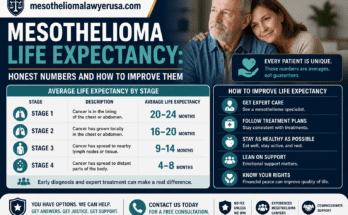

A mesothelioma diagnosis raises immediate questions about the future. Patients and families want clear information about survival rates and what influences prognosis. Statistics provide a general picture, yet they cannot predict the course of any single person’s disease. Individual outcomes vary widely based on stage at diagnosis, cell type, overall health, response to treatment, and access to experienced care.
This article explains current understanding of survival patterns, the main factors that affect prognosis, and how to interpret the numbers in a realistic way. The goal is to give patients and families a grounded framework for discussions with their medical team.
Understanding Survival Statistics
Survival statistics for mesothelioma come from large groups of patients tracked over time. The most commonly reported figures are median survival (the point at which half of patients are still alive) and five-year survival rates.
For pleural mesothelioma, the most common form, median overall survival without treatment is often in the range of six to twelve months. With standard treatments the median generally falls between 12 and 21 months, though many patients live longer. Five-year survival for pleural mesothelioma remains relatively low overall, typically reported in the 5–15 percent range depending on the data source and patient population.
Peritoneal mesothelioma can show more favorable results in selected patients, especially those who undergo aggressive surgery combined with heated chemotherapy. In specialized centers, five-year survival for carefully chosen peritoneal patients has been reported substantially higher than for pleural disease.
These numbers are averages. They include patients diagnosed at different stages, with different cell types, and treated with varying approaches. Some people live only a few months; others live several years or longer. Statistics describe groups, not individuals.
Key Factors That Influence Prognosis
Stage at diagnosis is one of the strongest predictors. Disease confined to the original site offers more treatment options and generally longer survival than cancer that has spread extensively. Unfortunately, many cases are diagnosed at a later stage because early symptoms are vague.
Cell type (histology) matters significantly. Epithelioid mesothelioma, the most common subtype, tends to grow more slowly and respond better to treatment than sarcomatoid or biphasic forms. Patients with pure epithelioid tumors often have longer average survival.
Tumor location also plays a role. Pleural mesothelioma and peritoneal mesothelioma behave differently and are treated with different strategies. Pericardial and testicular forms are rare and have their own patterns.
Overall health and performance status influence both treatment tolerance and survival. Patients who are stronger and have fewer other medical problems can often undergo more aggressive therapy and recover more effectively.
Age shows a statistical association—younger patients on average live longer—but chronological age is less important than functional status and the ability to tolerate treatment.
Response to therapy is highly individual. Some patients experience significant tumor shrinkage or prolonged stability with chemotherapy, immunotherapy, or multimodal treatment. Others have more limited benefit. Biomarkers and genetic features of the tumor are increasingly used to help guide treatment choices.
How Treatment Affects Outlook
Treatment does not cure most patients, yet it frequently extends survival and improves symptom control.
Surgery, when feasible, can remove visible disease and is often combined with chemotherapy or radiation. Patients who are candidates for aggressive surgical approaches at high-volume centers tend to show better average outcomes than those treated with non-surgical methods alone.
Chemotherapy remains a standard option for many patients. Immunotherapy has expanded the available tools and has improved results for some people, particularly those whose tumors have certain characteristics.
Multimodal treatment—combining surgery, systemic therapy, and sometimes radiation—produces the longest survival figures in published series for appropriately selected patients. Clinical trials continue to test new combinations and targeted approaches.
Supportive and palliative care play an essential role at every stage. Effective management of pain, breathing difficulty, nutrition, and emotional distress directly affects quality of life and can influence the ability to continue disease-directed treatment.
Interpreting the Numbers Realistically
Median survival figures can sound discouraging. It is important to remember several points:
- Half of patients live longer than the median.
- Averages include people diagnosed at advanced stages and those who received older forms of treatment.
- Outcomes at specialized mesothelioma centers are often better than national averages because of greater experience and access to comprehensive care.
- Newer therapies continue to shift the statistics gradually upward for some patient groups.
Prognosis is not fixed at the moment of diagnosis. It is reassessed over time as the disease responds (or does not respond) to treatment and as the patient’s overall condition changes.
Questions to Discuss with the Medical Team
Patients and families benefit from direct conversations with their oncologist. Useful questions include:
- What stage and cell type do I have?
- What treatment options are realistic given my health and the extent of disease?
- What results have you seen in patients with similar characteristics?
- Are there clinical trials that might be appropriate?
- How will we measure whether treatment is helping?
- What supportive care is available to manage symptoms?
Clear communication helps align expectations and treatment decisions with the patient’s goals.
The Importance of Specialized Care
Mesothelioma is uncommon. Physicians and centers that treat a higher volume of cases are more familiar with the nuances of diagnosis, surgical selection, systemic therapy sequencing, and symptom management. Seeking a second opinion at a specialized program is often worthwhile, even if travel or logistics are required.
Pathologists experienced with mesothelioma can confirm the diagnosis and cell type accurately—an essential step because treatment planning depends on precise classification.
Looking Beyond Statistics
Survival rates measure length of life. Quality of life is equally important to most patients. Many people focus on remaining as comfortable and functional as possible, maintaining relationships, and addressing practical matters such as financial and legal planning.
Support from palliative care teams, social workers, mental-health professionals, and patient networks can make a meaningful difference in day-to-day experience regardless of the numerical prognosis.
Frequently Asked Questions
What is the average life expectancy with mesothelioma?
Median survival for pleural mesothelioma with treatment is often reported between 12 and 21 months. Individual outcomes range from a few months to several years or more.
Does stage strongly affect survival?
Yes. Earlier-stage disease generally carries a better prognosis than advanced disease, although many cases are diagnosed later.
Which cell type has the best outlook?
Epithelioid mesothelioma typically has a more favorable prognosis than sarcomatoid or biphasic types.
Can treatment significantly extend survival?
Yes. Multimodal therapy, immunotherapy, and care at experienced centers have improved outcomes for many patients compared with supportive care alone.
Are peritoneal mesothelioma survival rates better?
In selected patients treated with cytoreductive surgery and heated chemotherapy, longer survival is often reported compared with typical pleural mesothelioma figures.
Do statistics predict what will happen to me?
No. Statistics describe large groups. Your outlook depends on multiple personal factors that only your medical team can evaluate.
Should I consider a clinical trial?
Clinical trials can provide access to newer approaches. Discuss eligibility and potential benefits and risks with your oncologist.
Internal and External Linking Suggestions
Internal links:
- Link “mesothelioma stages” to a detailed staging explanation.
- Link “treatment options” to pages covering surgery, chemotherapy, and immunotherapy.
- Link “clinical trials” to guidance on finding and evaluating studies.
- Link “palliative and supportive care” to resources for symptom management.
External authoritative sources:
- National Cancer Institute or SEER data on mesothelioma survival.
- American Cancer Society information on prognosis and survival.
- Peer-reviewed reviews in journals such as the Journal of Thoracic Oncology.
- Guidelines from professional organizations such as NCCN or ASCO when publicly available.
- Mesothelioma Applied Research Foundation educational materials.
Closing Perspective
Mesothelioma survival statistics provide context, not a personal forecast. Stage, cell type, overall health, treatment response, and the expertise of the care team all influence individual outcomes. Many patients live longer than the median figures, especially when treated at experienced centers with modern therapies.
Open discussion with the medical team, realistic goal-setting, and attention to both length and quality of life help patients and families navigate the uncertainty. Advances in treatment continue to improve the outlook for some people, and supportive care remains valuable at every stage.
This article is for educational purposes only. It does not replace personalized medical advice. Prognosis and treatment decisions should always be discussed with qualified oncology specialists familiar with the individual case.