
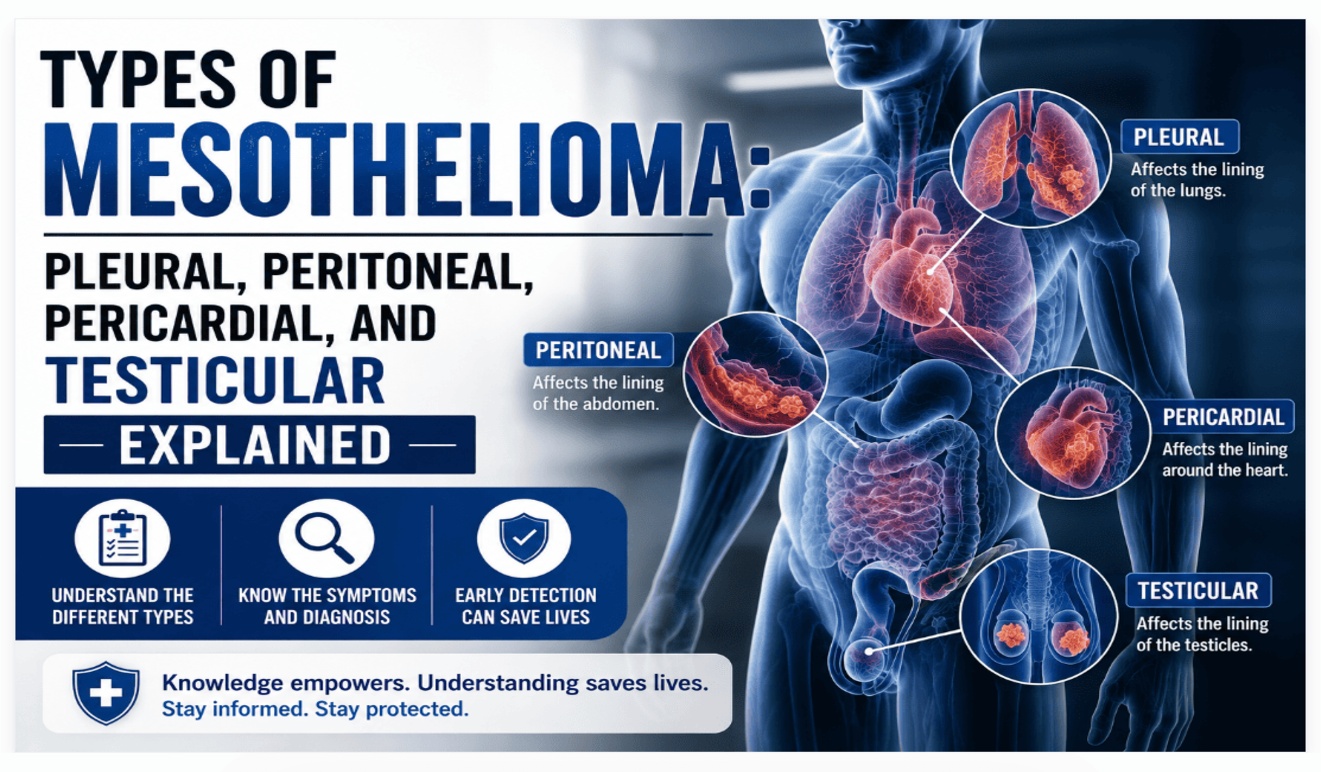
Mesothelioma is a rare cancer that develops in the mesothelium, the thin layer of tissue that lines and protects many internal organs. Although people often speak of mesothelioma as a single disease, it is classified into different types based on where the cancer begins. The location strongly influences symptoms, diagnostic approach, treatment options, and overall outlook.
The four recognized types are pleural, peritoneal, pericardial, and testicular mesothelioma. Pleural and peritoneal forms account for the vast majority of cases. Pericardial and testicular mesothelioma are extremely rare. Understanding these distinctions helps patients and families have more informed conversations with their medical teams.
Pleural Mesothelioma
Pleural mesothelioma develops in the pleura, the membrane that surrounds the lungs and lines the inside of the chest cavity. It is by far the most common type, representing roughly three-quarters of all mesothelioma diagnoses.
Asbestos fibers that are inhaled can become trapped in the pleural lining. Over many years the fibers cause chronic irritation that may lead to cancerous changes. Because the disease grows in the chest, early symptoms usually involve breathing and the respiratory system.
Common symptoms include shortness of breath, persistent cough, chest pain or tightness, unexplained fatigue, and fluid buildup around the lung (pleural effusion). Some patients also experience weight loss, night sweats, or a feeling of heaviness in the chest.
Diagnosis typically begins with imaging such as chest X-ray or CT scan, followed by biopsy to confirm the presence of mesothelioma cells and determine the cell type (epithelioid, sarcomatoid, or biphasic). Staging evaluates how far the disease has spread within the chest and beyond.
Treatment options may include surgery (when the disease is sufficiently contained), chemotherapy, immunotherapy, radiation, or combinations of these approaches. The choice depends on stage, cell type, and the patient’s overall health. Specialized centers with experience in thoracic surgery and mesothelioma care generally offer the widest range of options.
Peritoneal Mesothelioma
Peritoneal mesothelioma arises in the peritoneum, the membrane that lines the abdominal cavity and covers the abdominal organs. It accounts for most of the remaining cases after pleural mesothelioma, typically around 10–20 percent of diagnoses.
Asbestos fibers can reach the abdomen through swallowing or lymphatic spread. The disease often produces abdominal symptoms that can be mistaken for more common digestive or gynecologic conditions.
Typical early signs include abdominal swelling or bloating (often from fluid accumulation called ascites), abdominal pain or discomfort, changes in bowel habits, nausea, early fullness when eating, and unexplained weight loss. Women may initially be evaluated for ovarian or other pelvic conditions because the symptoms overlap.
Diagnosis relies on imaging of the abdomen, analysis of fluid if present, and tissue biopsy. Cell type again plays an important role in treatment planning.
For selected patients, a specialized surgical approach called cytoreductive surgery combined with hyperthermic intraperitoneal chemotherapy (HIPEC) can be considered. In this procedure surgeons remove visible tumor and then circulate heated chemotherapy directly within the abdomen. Systemic chemotherapy and other therapies are also used. Outcomes for peritoneal mesothelioma can be more favorable than for pleural disease in patients who are candidates for aggressive surgical treatment at experienced centers.
Pericardial Mesothelioma
Pericardial mesothelioma develops in the pericardium, the thin sac that surrounds the heart. It is very rare, representing less than 1 percent of all mesothelioma cases.
Because the tumor grows near the heart, symptoms often relate to cardiac function. Patients may experience chest pain, heart palpitations, shortness of breath, fatigue, or signs of fluid accumulation around the heart (pericardial effusion). In advanced cases the tumor can restrict the heart’s ability to fill properly.
Diagnosis is challenging due to the rarity of the disease and the nonspecific nature of the symptoms. Imaging of the chest and heart, echocardiography, and ultimately biopsy are required for confirmation.
Treatment options are limited by the tumor’s location and the difficulty of performing extensive surgery near the heart. Approaches may include careful surgical resection in selected cases, chemotherapy, radiation, or palliative measures to control fluid and relieve symptoms. Care is usually coordinated among cardiologists, thoracic surgeons, and oncologists.
Testicular Mesothelioma
Testicular mesothelioma (also called mesothelioma of the tunica vaginalis) arises in the membrane that surrounds the testis. It is the rarest form of the disease.
The most common presentation is a painless scrotal mass or swelling, sometimes accompanied by fluid buildup around the testicle (hydrocele). Because the symptoms resemble other, far more common testicular conditions, the diagnosis is often made only after surgery or detailed pathological examination.
Treatment generally involves surgical removal of the affected testis and surrounding tissue. Additional therapy such as chemotherapy may be recommended depending on the extent of disease and pathological findings. Because so few cases occur, treatment decisions are individualized and often guided by experience with other forms of mesothelioma.
Comparing the Four Types
| Type | Location | Approximate Frequency | Typical Early Symptoms | Primary Treatment Considerations |
|---|---|---|---|---|
| Pleural | Lining of the lungs | ~75% | Shortness of breath, cough, chest pain | Surgery (selected cases), chemo, immunotherapy, radiation |
| Peritoneal | Lining of the abdomen | ~10–20% | Abdominal swelling, pain, digestive changes | Cytoreductive surgery + HIPEC (selected cases), systemic therapy |
| Pericardial | Lining of the heart | <1% | Chest pain, palpitations, breathing difficulty | Limited surgery, systemic therapy, symptom control |
| Testicular | Lining around the testis | Very rare | Scrotal mass or swelling | Surgical removal, possible additional therapy |
Cell type (epithelioid, sarcomatoid, or mixed) further influences outlook and treatment response across all locations. Epithelioid tumors generally carry a more favorable prognosis than sarcomatoid ones.
Why Location Matters for Patients
The site of origin affects nearly every aspect of care. Symptoms guide the initial medical evaluation. Imaging and biopsy techniques differ. Surgical options, when available, are highly specialized and require teams experienced with the specific form of the disease. Prognosis statistics also vary by type, with peritoneal mesothelioma sometimes showing longer survival in patients who undergo successful cytoreductive surgery.
Because mesothelioma is uncommon, seeking care at a center that treats a meaningful number of cases can improve access to accurate diagnosis, appropriate surgical expertise, clinical trials, and comprehensive supportive care.
Frequently Asked Questions
Which type of mesothelioma is most common?
Pleural mesothelioma is by far the most common, accounting for the majority of diagnoses.
Is peritoneal mesothelioma more treatable than pleural?
In selected patients, aggressive surgical treatment combined with HIPEC has produced longer survival figures than are typically seen with pleural disease. Suitability depends on many individual factors.
Are pericardial and testicular mesothelioma caused by asbestos?
Asbestos is still considered the primary risk factor, although the exact pathway of fiber reach to these sites is less clearly established than for pleural disease.
Can the type of mesothelioma change over time?
The primary location remains the same. Cell type is determined by pathology and does not usually change, although tumors can show mixed features.
Does the type affect legal claims?
The underlying cause—most often asbestos exposure—matters more for legal purposes than the specific site of the tumor. Documentation of exposure remains important regardless of type.
How is the type confirmed?
Definitive diagnosis requires tissue biopsy and examination by a pathologist experienced with mesothelioma. Imaging helps locate the disease but cannot by itself establish the diagnosis or cell type.
Should patients seek a second opinion?
Yes. Because these cancers are rare, a second opinion at a specialized center is often valuable for confirming the diagnosis and reviewing treatment options.
Internal and External Linking Suggestions
Internal links:
- Link “pleural mesothelioma treatment” to a detailed page on thoracic approaches.
- Link “peritoneal mesothelioma and HIPEC” to information on cytoreductive surgery.
- Link “mesothelioma symptoms” to early warning signs by type.
- Link “asbestos exposure” to risk factors and occupational history.
External authoritative sources:
- National Cancer Institute overview of malignant mesothelioma.
- American Cancer Society information on mesothelioma types and treatment.
- Peer-reviewed reviews in the Journal of Thoracic Oncology or related journals.
- Guidelines from professional societies such as the National Comprehensive Cancer Network (when publicly accessible).
- Mesothelioma Applied Research Foundation educational resources.
Closing Perspective
Mesothelioma is not a single uniform disease. The four main types—pleural, peritoneal, pericardial, and testicular—differ in location, frequency, symptoms, and available treatments. Pleural mesothelioma is the most common, while pericardial and testicular forms are exceptionally rare. Accurate identification of the type and cell subtype is essential for proper treatment planning.
Patients benefit from care teams that understand these distinctions and have experience with the specific form of the disease. Clear information about the type of mesothelioma helps guide both medical decisions and practical planning for patients and families.
This article is for educational purposes only. It does not replace personalized medical advice. Diagnosis and treatment decisions should always be made in consultation with qualified oncology specialists.